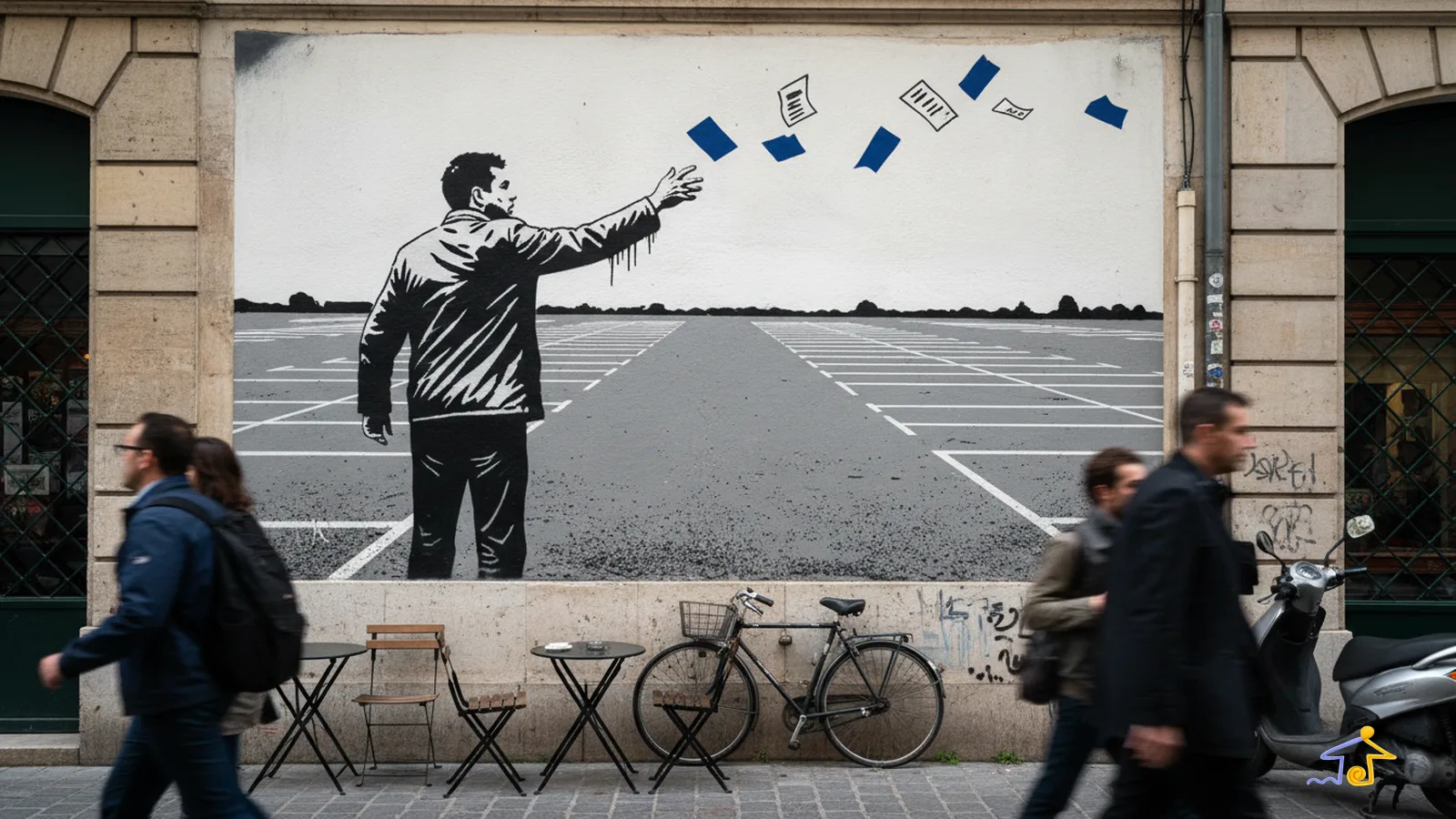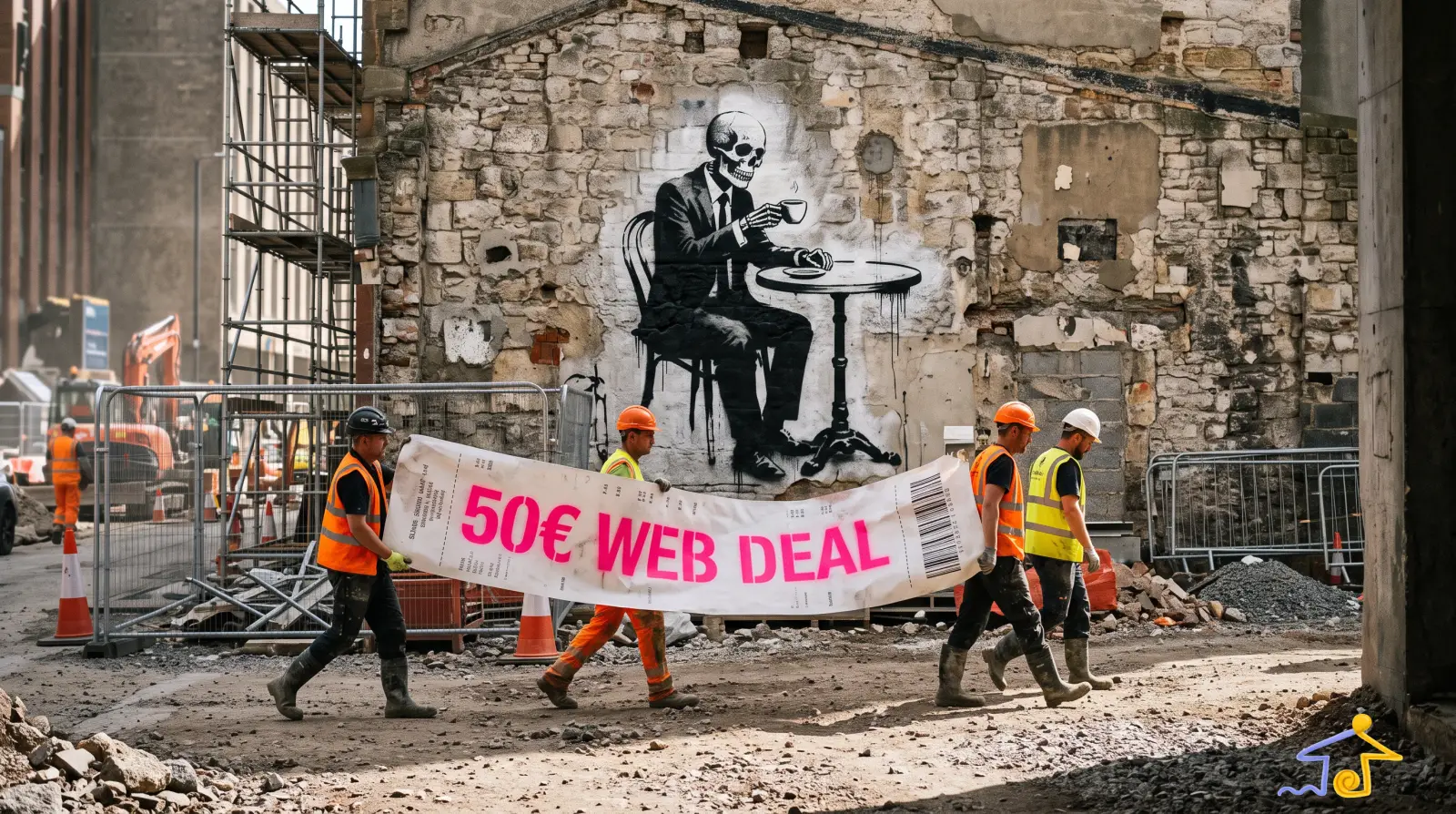
Picture it: it's Tuesday morning, you've just handed over the keys to room 4 and the couple for room 7 arrives in ten minutes. You open your inbox: “Your professional website for 50 euros, online in 24 hours”. Less than tonight's dinner. It looks like the deal of the year.
The problem is that the price isn't the bill: it's the starter. The real bill comes later, in instalments, and you often don't even see it, because you pay it in customers who never called you. And the same goes for the 250 or 1,000-euro website, if the same stuff is inside.
This article does one thing: it lines up the items the flyer leaves out. So you decide with the numbers in front of you, not in a hurry.
What do you actually buy for 50 euros?
Usually you buy the first year of something, not a website. Those 50 euros cover a ready-made template, a corner of a shared server and sometimes the domain (your address, like yourname.com), for twelve months.
What almost always stays out:
- renewals from year two, at full price;
- maintenance: updates, security, backups;
- changes: “I'd like to swap a photo” turns into a quote;
- the work that gets you found on Google;
- your time, the most expensive item of all.
It's the 30-euro printer: the seller doesn't make money on the printer, they make it on the ink.
Why does a cheap website cost so much even when it works?
Because it's usually slow, and a slow website doesn't break: it stops bringing you customers. No alarm, no error message. Just a phone that rings less.
Google has measured it. When a page opened on a phone takes 3 seconds instead of 1, the probability of the visitor leaving rises by 32% (Think with Google). Two seconds: the length of a yawn.
The causes are almost always the same:
- bloated templates, full of features you'll never use;
- add-ons (plugins) stacked one on top of the other;
- photos uploaded straight from the phone;
- servers shared with thousands of other sites.
It's like setting off on holiday with a boot full of bricks: the car starts, but on the first hill everyone overtakes you.
And Google notices. With Core Web Vitals, a page's “vital signs” (speed, stability, responsiveness), it also weighs how visitors find the experience. With equal content, the slower site starts behind.
How much does a lost customer cost you?
More than the website, almost always. You can do the sum in a minute with your own numbers: visits a month, how many people get in touch, what a customer is worth. If slowness takes even one away now and then, the saving on the website is already gone.
The back-of-the-envelope sum, with example numbers
300 visits a month from phones. 2% get in touch: that's 6 enquiries. You close one in three: 2 customers a month, worth 400 euros each.
If slowness costs you one enquiry in six, that's one enquiry fewer a month, so roughly 4 fewer customers a year. 4 × 400 = 1,600 euros a year, 4,800 over three years. To save money on the website.
And for the professionals: in a study for Google, Milliseconds Make Millions, Deloitte found that one tenth of a second less on mobile went hand in hand with +8.4% conversions in online retail and +10.1% in travel. These are averages from large brands, not a promise. But that's the direction.
Is the website really yours?
Often it isn't. In many cheap offers the domain is in the agency's name, or the site lives on a platform you can't leave. As long as everything is fine, nobody notices. The day you want to switch, you find out you were renting.
8 questions to ask before you sign (at any price)
Get the answers in writing:
- Whose name is the domain in? It should be yours, with access to the control panel.
- Can I have the transfer code whenever I want? It's called AuthInfo or EPP: like keeping your phone number when you change carrier, but for your website.
- If I change provider, do texts, photos and files come with me?
- Who owns the data? Contacts, statistics, submitted forms.
- How much is the renewal from year two? A figure, not “it depends”.
- What does maintenance include? And who answers if the site goes down on a Saturday?
- How long does it take to load on a phone? You can check it yourself, for free, with Google's PageSpeed Insights.
- How will I know how many people contact me through the site? If nobody measures it, nobody improves it.
If three of these answers are vague, the low price has just found its explanation.
So if I pay 250 euros, am I safe?
Not necessarily. Spending more buys you a different price tag, not a better website. There are websites costing a few hundred euros that are the same bloated template, on the same crowded server, with the domain in someone else's name. Just more expensive.
The price alone tells you nothing: the eight questions do. And if all you need is a page for an event, a package is perfectly fine. The problem starts when you ask that site to be your salesperson: find customers, win them over, bring them back. At that point, being online isn't enough. It has to work: that's the difference between a package website and one built to work.
What to do tomorrow
Open PageSpeed Insights, paste your website's address and look at the mobile score. Then take the eight questions and ask whoever runs your site. If the answers add up, good: you paid the right price. If not, get in touch: we'll look at it together, with the numbers in front of us.